

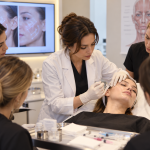
Hands-on training matters in medical aesthetics distribution because injectable products are only as safe and effective as the practitioner using them. Reading a product sheet teaches what a filler or skin booster is made of; supervised practice teaches where, how deep, and how much to inject, and what to do when something does not go as planned. For clinics choosing a supply partner, the level of practical product education that comes with a product is a real part of its value, alongside price and availability.
This article explains why practical training carries so much weight in injectable aesthetics, what good training support actually covers, and what clinics and distributors should look for.
THE PRODUCT IS ONLY HALF OF THE TREATMENT
Two clinics can buy the same hyaluronic acid filler, the same biostimulator, or the same skin booster and see very different results. The difference is rarely the product itself. It comes from patient assessment, product selection for the area, injection depth and technique, and how well the practitioner understands facial anatomy.
This is especially true as injectable lineups grow more varied. A modern clinic may stock volumizing fillers, lip products, skin boosters, and collagen-stimulating products, each with a different gel structure and a different recommended technique. A technique that suits a hydration-focused skin booster can underperform with a structural filler, and the reverse is also true. Product knowledge and technique knowledge have to move together.
WHY THEORY ALONE IS NOT ENOUGH
Published clinical literature consistently links practitioner expertise to complication rates. A 2025 systematic review and meta-analysis on vascular occlusion after dermal filler injections identified injector expertise and technique as significant factors, and highlighted the glabella, nose, and nasolabial folds as the regions most often associated with serious adverse outcomes. A 2024 review of vascular complications reached a similar conclusion: anatomical knowledge, careful technique, and early intervention are the pillars of both prevention and management.
Vascular occlusion is rare, but it is time-sensitive and potentially severe, with consequences that can include tissue damage and, in the most serious cases, vision problems. Recognizing early warning signs and responding with a clear protocol is a skill that is built through supervised practice, not just reading. This is the core argument for hands-on training: it turns knowledge into reflex.
WHAT GOOD HANDS-ON TRAINING SUPPORT COVERS
Not every training program is equal, and the label alone says little. Effective practical support typically includes:
Facial anatomy in applied form. Vascular anatomy, danger zones, and safe injection planes taught as working knowledge rather than a refresher slide.
Product-specific technique. How a given gel behaves, which depth and method suits it, and which treatment areas it is formulated for.
Supervised live practice. Injecting under the observation of an experienced practitioner, with real-time feedback, so that technique is corrected early rather than learned by trial and error on patients.
Complication preparedness. Recognizing early warning signs, understanding escalation steps, and knowing what emergency protocols and supplies should be in the room before a treatment starts.
Ongoing education. New products, new indications, and updated consensus guidance appear every year, so a single course at the start of a career is not enough.
WHY IT MATTERS SPECIFICALLY IN DISTRIBUTION
Distribution is where product and practitioner meet. A distributor who supplies product with no context leaves the clinic to work out the rest alone. A distributor who treats practical education as part of the relationship helps clinics adopt new products with more confidence, reduces avoidable misuse, and builds a supply relationship that lasts beyond a single order.
There are clear commercial reasons for this too. Clinics that understand a product well tend to reorder it consistently, expand into adjacent products in the same category, and recommend it to colleagues. Poor outcomes from poorly matched technique, on the other hand, tend to be blamed on the product, and the damage reaches the whole supply chain.
This matters even more in the current market. Demand is shifting toward biostimulators, skin boosters, and combination protocols, which are treatments that rely more heavily on technique and protocol knowledge than simple single-product volumizing. As clinics broaden their range to meet that demand, the need for practical product education grows with it.
WHAT CLINICS SHOULD ASK A SUPPLY PARTNER
When evaluating a source for injectables, it is worth asking early:
- What product education is available for the products I am ordering?
- Is practical, hands-on support offered, or only written product information?
- Does that support cover newer products and techniques as the range evolves?
- Does the partner understand the clinical use of what they supply, or only the logistics?
Answers to these questions say a lot about whether a supplier sees clinics as customers or as long-term partners.
FREQUENTLY ASKED QUESTIONS
Why is hands-on training important for injectable aesthetics?
Hands-on training builds practical competence in injection technique, depth selection, and complication recognition that written materials alone cannot teach. Clinical reviews link practitioner expertise and technique to lower rates of serious complications such as vascular occlusion.
What should hands-on injector training include?
Effective training combines applied facial anatomy, product-specific technique, supervised practice with real-time feedback, complication management protocols, and ongoing education as new products and guidance emerge.
Can a clinic safely use a new filler or skin booster based on the product sheet alone?
A product sheet explains composition and intended use, but technique, depth, and patient selection are learned through practice. Different gel structures behave differently in tissue, so product-specific training is strongly recommended before introducing a new product.
Why should a distributor care about training support?
Training support improves treatment outcomes, reduces avoidable misuse, and builds longer-lasting relationships with clinics. Clinics that understand a product well tend to reorder it and adopt related products with more confidence.
What is vascular occlusion and why is it discussed so often in injector training?
Vascular occlusion occurs when filler blocks or compresses a blood vessel, restricting blood flow to surrounding tissue. It is uncommon but time-sensitive and potentially serious, which is why recognition and response protocols are considered a core part of injector education.
For clinics and distributors planning their 2027 product range, it is worth treating practical product education as part of the sourcing decision from the start. If you would like to discuss your needs, get in touch with our team.
Sources: Risk Factor Analysis for Vascular Occlusions After Dermal Filler Injections, systematic review and meta-analysis (PMC, 2025); Adverse Effects Associated with Dermal Filler Treatments, Part II: Vascular Complications, Diagnostics (2024); CBAMedicine, Aesthetic Injectables Training Guide.
