

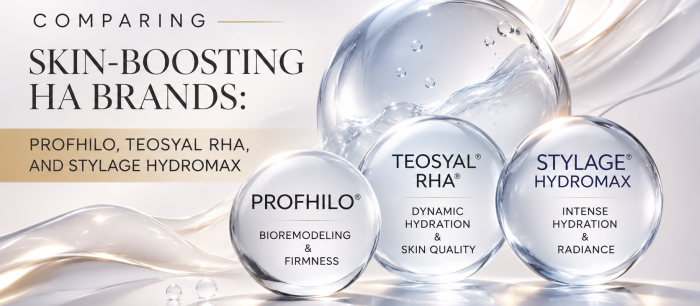
Profhilo, Teosyal and Stylage HydroMax are three of the most requested hyaluronic acid skin-quality products in aesthetic medicine, but they are built differently and used differently. Profhilo is a hybrid complex of high and low molecular weight HA placed at a fixed set of facial points. Teosyal’s skin booster, PureSense Redensity 1, is a non-crosslinked HA gel enriched with amino acids, antioxidants, minerals and vitamin B6. Stylage HydroMax is a superficial-dermis mesotherapy product from Laboratoires Vivacy designed for deep hydration of very dry skin. This guide compares them on composition, technique, treatment protocol and typical use, so clinics can match the right product to the right patient.
WHAT A SKIN BOOSTER IS (AND IS NOT)
Skin boosters are injectable products built to improve hydration, elasticity and overall skin quality rather than to fill a fold or add structural volume. Where a traditional filler is chosen to correct a specific line or restore a specific area, a skin booster is chosen to treat the skin itself: dryness, dullness, fine texture and early laxity. That difference shapes everything else, including gel design, injection depth, number of sessions and how results are judged.
A note on naming: the Teosyal RHA collection (RHA 1, 2, 3, 4 and RHA Kiss) is Teoxane’s range of dynamic fillers for moving areas of the face. Teoxane’s skin-quality product is Teosyal PureSense Redensity 1, so that is the product compared here.
PROFHILO
Profhilo is made by IBSA Farmaceutici in Italy. Each 2 mL syringe contains 64 mg of hyaluronic acid: 32 mg of high molecular weight HA (about 1100 to 1400 kDa) and 32 mg of low molecular weight HA (about 80 to 100 kDa). The two are combined into stabilized hybrid complexes using NAHYCO Hybrid Technology, without chemical cross-linkers such as BDDE.
Technique: Profhilo is placed using the BAP technique (Bio Aesthetic Points), at five specific points on each side of the face. It is designed to spread through the tissue after injection rather than create a visible shape.
Protocol: two treatments, usually one month apart, followed by top-up sessions chosen by the practitioner. Product information describes effects lasting around six months, depending on the patient and the degree of correction needed.
Best suited to: skin laxity, loss of firmness and general skin quality concerns across the face and neck, where a regenerative approach is preferred over volumizing.
TEOSYAL PURESENSE REDENSITY 1
Teosyal PureSense Redensity 1 is made by Teoxane Laboratories in Switzerland. It contains 15 mg/mL of non-crosslinked hyaluronic acid with 3 mg/mL of lidocaine, plus a nutrient complex: eight amino acids (glycine, lysine, threonine, proline, leucine, arginine, valine and isoleucine), the antioxidants alpha-lipoic acid, N-acetyl-L-cysteine and glutathione, the minerals copper and zinc, and vitamin B6.
Technique: product information describes several pre-injections of 0.05 mL boluses to improve the effect of the lidocaine, then a multi-bolus technique in sun-exposed areas or a multi-puncture technique in less sun-exposed areas, followed by massage to distribute the gel evenly.
Protocol: results are described as lasting at least three months, with maintenance suggested at two to three sessions per year.
Best suited to: dry, dull or sallow skin on the face, neck and décolleté, and patients whose main concern is replenishing the skin rather than lifting it.
STYLAGE HYDROMAX
Stylage HydroMax is made by Laboratoires Vivacy in France and sits in the brand’s mesotherapy range, separate from the structural fillers. Product information lists 12.5 mg/g of hyaluronic acid in a 1 mL syringe, and Vivacy positions HydroMax as its flagship hydration product, built around its Skin3 Complex. It is a different product from Stylage Hydro, which is listed at 14 mg/g of non-crosslinked HA.
Technique: mesotherapy-style injection into the superficial dermis, used on the face, neck, décolleté and hands.
Protocol: two sessions one month apart, depending on the level of dehydration, then one more session two months later if needed, with regular top-up sessions afterward.
Best suited to: very dry or dehydrated skin where deep, immediate hydration and improved elasticity are the priority. It is not a wrinkle-correction product.
SIDE-BY-SIDE SUMMARY
Profhilo: hybrid high and low molecular weight HA, 64 mg per 2 mL, no chemical cross-linkers, five-point BAP technique, two sessions one month apart, effects described as around six months.
Teosyal PureSense Redensity 1: non-crosslinked HA at 15 mg/mL with lidocaine, amino acids, antioxidants, minerals and vitamin B6, multi-bolus or multi-puncture technique, maintenance at two to three sessions per year.
Stylage HydroMax: HA at 12.5 mg/g, mesotherapy into the superficial dermis, two sessions one month apart with an optional third, positioned for deep hydration.
HOW TO CHOOSE BETWEEN THEM?
Three questions usually decide it. First, is the patient’s main concern laxity and firmness, or dryness and dullness? Profhilo’s hybrid design and fixed-point technique are built around the first, while Redensity 1 and HydroMax are built around the second. Second, how does the practitioner prefer to inject? Profhilo’s five-point protocol, Redensity 1’s multi-bolus or multi-puncture approach and HydroMax’s superficial mesotherapy are different workflows, and each works best when the practitioner is trained in it. Third, what does the patient want from the treatment: a skin-quality improvement over time, a nutrient-enriched formulation, or a deeply hydrating result?
It also helps to keep expectations grounded. Published clinical data on hybrid complexes is encouraging for hydration, elasticity and skin quality, but most studies are single-arm, before-and-after designs. Head-to-head trials comparing these specific products are scarce, so claims that one is simply the best should be treated with caution. The better question is which one fits the patient and the practitioner’s technique.
Many clinics keep two of these in their range and choose between them per patient rather than building a protocol around only one.
WHAT TO CHECK WHEN SOURCING SKIN BOOSTERS
Because these products are chosen on formulation details, it is worth confirming a few things before ordering:
The exact product and presentation. Concentration, syringe volume and pack format differ between products and between markets, so confirm that what you are ordering is the formulation your protocol is built around.
Packaging consistent with the manufacturer’s current documentation. Packaging and labeling change over time, so compare against the manufacturer’s published information.
Supply consistency. A source that can support recurring volume matters more than one-off availability, since a protocol built around one product depends on being able to reorder it.
FREQUENTLY ASKED QUESTIONS
What is the difference between Profhilo and Stylage HydroMax?
Profhilo is a hybrid complex of high and low molecular weight hyaluronic acid placed at five points per side of the face, designed around skin laxity and firmness. Stylage HydroMax is a mesotherapy product injected into the superficial dermis, designed around deep hydration of very dry skin.
Is Teosyal RHA a skin booster?
The Teosyal RHA collection is a range of dynamic fillers for areas of the face that move. Teoxane’s skin-quality product is Teosyal PureSense Redensity 1, which contains non-crosslinked HA with amino acids, antioxidants, minerals and vitamin B6.
How many sessions do skin boosters need?
It depends on the product. Profhilo is usually given as two sessions one month apart, Stylage HydroMax as two sessions one month apart with an optional third two months later, and Teosyal PureSense Redensity 1 is described with maintenance at two to three sessions per year.
Which skin booster lasts the longest?
Duration varies by patient, product and treatment area, and published head-to-head comparisons between these products are limited. Manufacturer information describes roughly six months for Profhilo and at least three months for Redensity 1, but results should be judged per patient.
Do skin boosters replace dermal fillers?
No. Skin boosters treat skin quality, such as hydration and elasticity, while fillers correct lines and restore volume. Many treatment plans combine the two.
Sources: Product information from IBSA Farmaceutici (Profhilo), Teoxane Laboratories (Teosyal PureSense Redensity 1) and Laboratoires Vivacy (Stylage Hydro and HydroMax) as published in product listings; Hybrid Cooperative Complexes of Low- and High-Molecular-Weight Hyaluronic Acid in Aesthetic Medicine, review (PMC).
